the grkvlt irregular publishing mechanism - enterprise java, web development, information security, statistics and probability, gambling, book reviews and technology discussion, together at last!
27/05/2015
What Really Happened to the Search Results?
What has happened is that using Google to search for the phrase what happened to the dinosaurs triggered a match on a book with a similar title: What Really Happened to the Dinosaurs by Ken Ham. His crime is to be a creationist. Can you believe it? Those sneaky Christians have gone and adjusted Google's search algorithm, so that when you search for the title of a book, you get back a bunch of information about the book. Think of the children!
Oh, wait. No. There's definitely a lack of critical thinking going on here somewhere, though. What's worse is all the oh-so-clever geniuses leaving 'feedback' about this, explaing how the result is incorrect because science! and similar. They semm to also have failed to notice this response to their submissions: Note: Your feedback won't directly influence the ranking of any single page. Probably because they are gleefully posting about how they have 'corrected' Google. They also appear to believe that despite this, the invisible hand of Google has listened to them, and removed the ofensive result, rather than what has actually happened - all the recent posts about the 'controversy' are weighted higher by the search algorithm, because they are more recent pages...
Grrr. If there's one thing I hate it's idiots like this who believe they are more intelligent that they are (see also Dunning-Kruger effect) and are blessed with super-rational skepticism that makes them infallibly right, unlike those poor benighted religionists. There's a time and a place for making fun of people who support flimsy beliefs with pretend science, and this is not it.
07/08/2012
Google TFA Security Issue
The following note describes a (serious) security vulnerability with Google accounts two-factor authentication, which I believe enabled complete TFA bypass and would therefore lead to full account access. I have raised this with Google, but it is a 'Known Issue' and no action is being taken, so they have no constraints on publication. I understand their security versus usability tradeoff, so this is mostly an exercise in full disclosure.
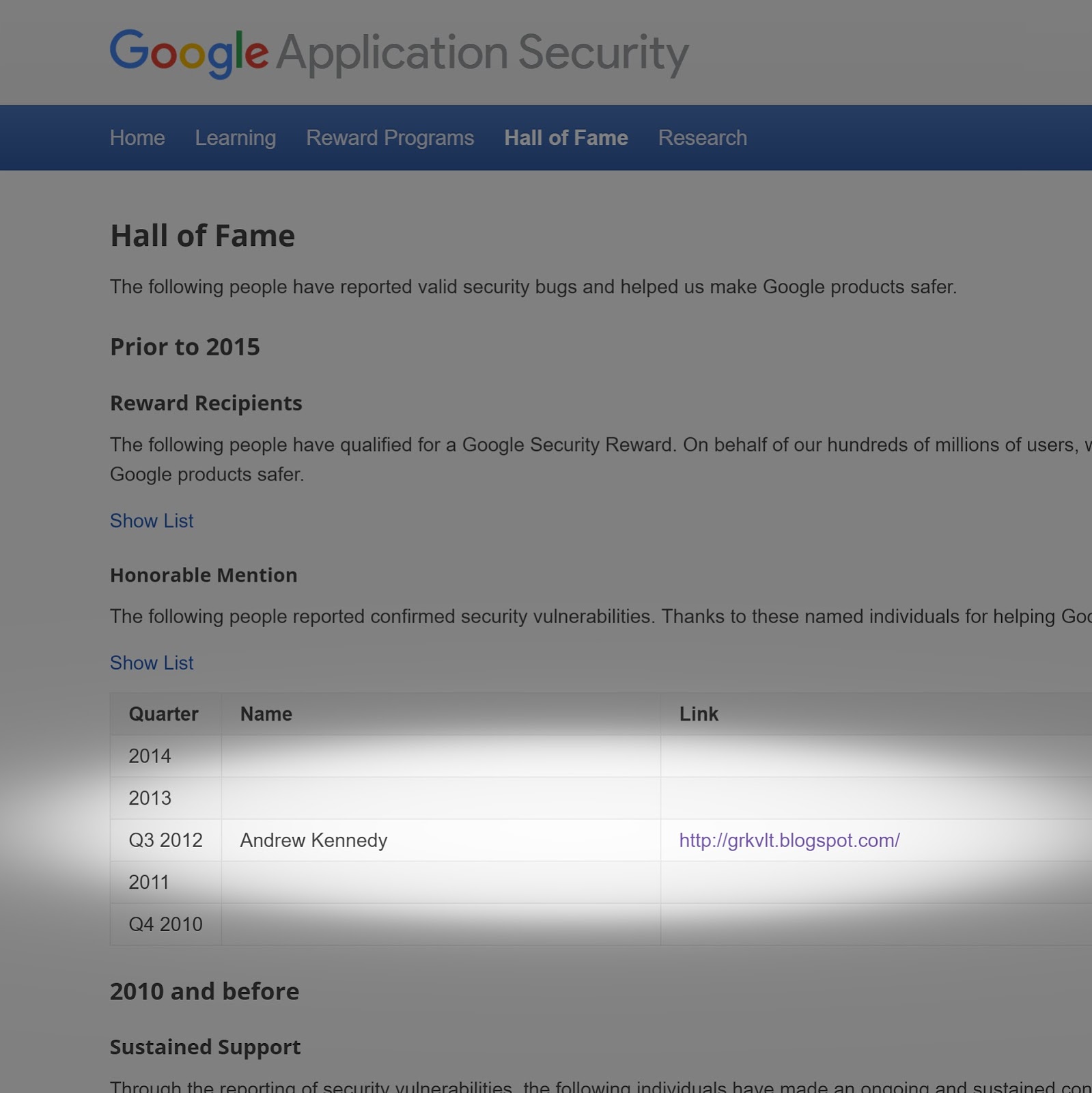
Since there was no bounty awarded, the issue was only recorded on the Honorable Mention list for Q3 2012. It can be found in the Prior to 2015 section of the Google Security Hall of Fame archive. If you want to verify that my name really is there you will need to click on the Show List link, and then search for Kennedy. The screenshot to the left is an edited copy of this page, created to highlight my entry, but there are a lot of other honourable mentions, so follow the link to see everything in context...
UPDATED 2013-02-25
The same issue has been discovered and blogged about by Duo Security researcher Adam Goodman - Bypassing Google’s Two-Factor Authentication and Hacker News discussion.
Issue
It is possible to bypass and disable two-factor authentication and re-enable it with a different Android device and phone number without ever knowing the account password or having access to an authorised authenticator or phone number.
Discovery
I enabled two-factor authentication or two-step verification [1] on my Google account last year, using an Android phone connected to an Orange PAYG SIM to generate the validation codes. In the process of moving flat, I lost this phone and also mislaid my printed set of backup codes. This meant that I was unable to authenticate myself to any of the Google account services over HTTP/HTTPS, as after accepting my password they all required the extra TFA code. These included the account and profile settings page, Google+, Blogger and other Google web properties such as YouTube.
In fact, the only Google services I could access were those for which I had an application-specific sixteen character password [2] already generated, and it was not possible to generate any further such passwords. Additionally, these passwords are not sufficient to log into any of the Google web sites, and attempts using them are rejected. The only approved way to disable TFA and regain access to Google sites was to go through the account recovery process [3] which requires detailed knowledge of the history of the account. Even as the owner of the account, I was unable to provide enough correct answers to satisfy Google support and regain access although I tried several times.
Using the vulnerability below I discovered that I was able to bypass the normal restrictions and re-configure the account security settings to give me access to my account again, and register my new phone and device instead.
Requirements
The following are required to gain access to a two-factor authentication protected account. Note that the main password is not needed, nor is access to any of the configured authentication devices or phone numbers.
- Any application specific password for the Google account (This can usually be obtained by examining the configuration files for an application using the password, or looking in the 'Keychain' on OSX or other operating system equivalent)
- Android 3.2.2 device (As tested, other versions may also work)
Process
The following process will enable full access to, and control of any Google account protected by two-factor authentication. I have tested this using my own Google account.
- Add the Google account to the Android device, giving the application-specific password as the credential
- Ensure 'Google automatic sign in' is enabled for the Android browser
- Access Google's homepage using the browser
- Click on 'account settings' or other link which requires authentication with Google
- The browser will automatically authenticate the account you will be logged in as the chosen account
- It is now possible to change all two-factor authentication settings, either disabling it completely or changing the configured device and phone numbers used to generate codes
Conclusion
This is a serious flaw, since users assume that their accounts cannot be compromised unless an attacker obtains the device used for authentication, or gains control of their authorised phone number, neither of which is required for this attack.
It is possible to log into an account protected by two-factor or two-step authentication without ever invoking this process or having access to the authorised device or phone. This bypasses all protections that are assumed to be provided by the service, allowing an attacker in possession of an application specific password to gain complete control over a two-factor protected account which the user assumes is safe.
References
23/09/2011
Reboot
I have recently started working at a new company, a cloud technology start-up based at Edinburgh University. Cloudsoft produce Monterey, a middleware framework for application mobility across various cloud infrastructure providers. I am developing the latest version of this, on which more later. It is a great environment to work in, with really smart colleagues and lots of challenges that keep me thinking. There are also the obvious benefits of being based in the University, such as very fast Internet and free access to academic journals.
Due to the scope of my work, I have found myself learning a lot of interesting new things. These range from picking up new languages (Groovy), libraries and APIs (jclouds, AWS, Seam CDI), applications (Redis, Karaf, Chef, Infinispan) as well as technologies (OSGi, PaaS). I am also working on open source projects during 20% of my time, which will mostly involve Qpid but I have also been investigating jclouds and elasticsearch. I hope to be able to write more about many of these topics.
01/08/2010
Silly, Mischievous Fools and Rogues
There would be widespread opposition to such a regulation as inconsistent with English liberty. Our tradition is that while orders issued by the duly constituted authority must be obeyed, every civilian is at liberty to show, if he can, that such orders are silly or mischievous and the duly constituted authorities are composed of fools or rogues [...] Accordingly we do not regard activities which are designed to bring the duly constituted authorities into contempt as necessarily subversive; they are only subversive if they are calculated to incite persons to disobey the law, or to change the Government by unconstitutional means. This doctrine gives, of course, great and indeed dangerous liberty to persons who desire revolution, or desire to impede the war effort [...] but the readiness to take this risk is the cardinal distinction between democracy and totalitarianism.
Sir Alexander Maxwell
06 September 1940
13/02/2010
LEGO Games 3835 Robo Champ
This is an excellent game, both conceptually and in actual execution. It consists of LEGO pieces, and instructions to build three brightly coloured, cartoon style robots and one die. All the robot LEGO pieces provided are standard shapes and sizes, as found in any conventional LEGO set, and there are 118 separate pieces in total. The only custom part is the die, which accepts 2x2 tiles on each face (or combinations of two 2x1 or four 1x1 tiles) so you can re-use parts or build extra robots if desired. The robots themselves are fairly simple to build and great to look at and play with once built - in fact the set would be worth it just as a three-robot kit, I feel! Once built, the robot arms, legs and heads are detatchable by design, and this is an essential feature of the game...
There is a contest at the robot factory. The first to build a robot with all the correct colour parts will win this year’s trophy and be named the Robo Champ. If someone takes a part you need you may have to steal it back to achieve victory. A fast and fun game to play again and again for 2 to 3 players. Game play approximately 10-15 minutes.
Gameplay is quite straightforward, with the amusing back-story above presented in the instructions. Players take turns rolling the die and each get to pick, swap or steal an appropriately coloured robot part depending on the colour shown. In line with the spirit of LEGO, the rules are malleable, and it is suggested that players and families develop their own sets. I felt that the initial set of rules was complex enough to provide a fun game, but still easy to learn. The first game I played took around ten to fifteen minutes, just as suggested on the box, which included the learning time. Of course it also took some time beforehand to build the robot pieces involved, which will depend on your individual LEGO skills.
One caveat for this set is based on my experience with the recipient of the set I purchased, my young nephew. He is slightly younger than the suggested minimum of six years old, but has very readily grasped the idea behind building LEGO models from their instruction sheets, and loves robots of all kinds! He found it hard to grasp that his beloved new robots had to be taken to pieces after he built them so carefully, and also had difficulty accepting that he might not be able to re-build the robot with the correct parts. I think that older children would be able to understand this aspect of co-operative gameplay automatically, but it is a point to note if buying this for younger children. Also, the next time he plays, he will not have just built the new robots, so will be less apprehensive about their impending destruction.
There are several other LEGO game sets which intrigue me, such as Creationary and Lunar Command. i think this is a great idea from LEGO, and hope they continue the theme. Sadly, some sets, like Knight's Kingdom Chess Set are no longer available, but i think a quick look on eBay would probably net a copy.
LEGO® is a trademark of the LEGO Group of companies which does not sponsor, authorize or endorse this site.
04/02/2010
Brain Overflow
Anyway, the creators have spun off the software behind it as a stand-alone product for community question-and-answer sites as StackExchange. They sell consultancy and services as well as hosted versions of the software as white-label sites, and give away free access for non-commercial usage. It's a nice business model which I'd love to copy with my own software...
While looking at some of these associated sites, I discovered Math Overflow, which makes Andrew feel stupid.. This is chock full of people asking about non-trivial isomorphisms, homologous cauchy integral groups over non-integral fields, and getting intelligent answers! Of course, there's also lots of homework questions, and potentially unanswerable stuff in there too. I really like some of the philosophical discussions that pop up, as well as the more basic questions which are good at reminding me how much of my education I've forgotten due to alcohol and time...
The whole point of this post is that I found this amazing video, which is a sphere being turned inside-out in the most awesome way possible, with a little help from Pixar and the University of Minnesota. The frame shown is above is just part of the transformation, which is very clearly explained. The whole video is just over 20 minutes long, and I suggest you watch it all the way through, as it's pretty cool (and probably expensive, counting the number of grants that funded it...) animation for 1994.
18/04/2009
Working Standards
one of the only problems so far is the continuous integration system, which is set up with a very strict set of checkstyle and PMD rules for code quality. i'm all in favour of managing code quality as an automated process and continuous integration with these tools is a Good Thing, but i keep falling foul of some of the rules, in particular the checks for multiple return statements in one method, to enforce single exit points. i believe writing methods with guard clauses up front is the most readable and elegant way of expressing certain types of logic, and apparently martin fowler agrees (see his refactoring book) with me. the following discussion on stackoverflow is relevant, too. also, there are strict rules on long variable names, which keep me from naming things like constraintDefinition or workflowInstance although i do agree with the restriction on short (less than four characters) names.
i'm (really) going to try and make more of an effort to keep this blog updated more frequently, since it's over a year since i last posted ;)
16/03/2008
greenock central
sunset over greenock central station taken with panorama setting by stitching three landscape frames together using a sony ericsson camera phone.
29/02/2008
images from outer space...
I uploaded the images from Bruce to a Flickr set, and tagged them with a note indicating the asteroid's location, since it's very faint (magnitude 16.6 in these images). Also, to see more details, including the IAU discovery details and citation, as well as confusing orbital ephemeris and data, I have updated the Wikipedia article. This contains the image you can see here, which is a composite of the LONEOS frames, saved as an animated GIF to show the motion across the fixed stellar background. I really can't explain how much I appreciate the fact that Ted named this object after Malcolm, so I'd like to publicly thank him anyway.
02/10/2007
coming home present
the problem is, of course, whether to be happy that biggles likes me enough to give me his dead mice, *OR* to be worried that there is (was) a mouse (or mice) in my flat... maybe it's time to board up the hole in the bathroom wall before it gets colder?
seeing music, hearing pictures
the best ones i have seen are Johann Sebastian Bach, Toccata and Fugue in D Minor, Frederic Chopin, Etude, opus 10 #7 and Franz Liszt, Feux Follets. i think they look like some sort of bizarre 2D cellular automata evolving with the music
enjoy!
(see also the IBM glass engine, infinity edition - a java applet for exploring philip glass's musical works.)
bandwidth gadgets
the other reason for posting is that i finally got myself an interweb thing and my email and web-browser suddenly started working again! but no ADSL (no land line, rented property) or cable (not in my postcode, anyway) for me. instead, i now have a vodafone 3G data card in my laptop. it goes in the expresscard slot (although it does come with an adapter for PC card slots) so it looks nice and tidy, as opposed to the alternative white brick on the end of a USB cable i was offered. it does cost GBP 50.00 for the internal card, and the USB dongle is free, but there's no competition when you see them, and what else am i going to put in that slot anyway?
it's still the 3g data card that amazes me, though. i remember my first GSM modem card (in an apple newton, actually, connected to a motorola star-tac) which gave me 19.2Kbps with compression, if i was lucky. this card gives me 7.2Mbps (peak, confirmed) or 1.4 Mega-bytes per second. boggle.
09/10/2006
the tesco value experiment
and, there's more where they come from. since they all cost so little, my expectations were naturally low, and i can fairly say they were met, and possibly even exceeded. in particular, those teacakes are an amazing purchase and last for ages without going stale, as are the digestives. even the savoury rice and tomato pasta meals (not pictured) which are bags of rice/pasta with powdered sauce that require boiling in water/milk for 5-10 minues to cook are not overly dreadful. now, i know people are going to say why didn't i get vegetables and meat and so on - ingredients basically! and make my own meals? well, i'm pretty lazy, and also, i still think the 'value way' is cheaper.
another thing i noticed is that the value brand now extends way past food. you can buy value pens, pencils and paper, cameras, telephones, crockery, shampoo, irons, microwaves - i could go on... my experiment has thankfully ended, but i am convinced that although man may not live on bread alone, he could do it with tesc's value range, even on the dole...
10/09/2006
regarding web two point zero
you can also post items in your own categories, and add arbitrary new attributes. attributes are just name/value pairs, where the value is either a plain text string or one of several pre-defined types like numbers, date (range), URLs or locations (for google maps). these are displayed at the top of an item's display page. additionally you can add up to ten labels, which are similar to tags or keywords. these labels are used to group items, and for browsing, similarly to categories except that you may have membership of multiple label classes but only one category.
although i like the idea of submitting your own content to be hosted by google, with tags and semantic info for indexing, it appears that most of the information in the base is auto submitted from other sites, as a link to the item page and some meta-data. unfortunately, for items like books, cds and dvds or other physical objects, there are many online retailers selling them. it means that there are many copies of the information (meta data) on an item, sometimes conflicting, and no way of determining the definitive item's identity. this is a shame, because a database like this would be a good basis for some of the semantic web projects.
i'm not sure how google will rank the information though, since people can obviously submit anything - the wikipedia problem, basically, which they seem to have solved, admittedly. also, there aren't really any links to or from the google hosted content (yet) and this makes it hard to calculate a pagerank equivalent. interestingly, you can see recent searches on the base front page, which can be odd! but, they could use some of the search data to determine which items people looked at most and have this as part of the ranking data.
there are also vocabularies to describe links and relationships. for instance functional requirements for bibliographic records (FRBR) is a vocabulary that describes the relationships between works, such as parodyOf, excerptFrom, originalWork, reviewOf and so on. sites like IMDb provide a unique namespace for referencing movies, which can each be entered into base with the relevant meta data. then, any reviews, parodies or whatever can be easily linked to the unique identity of the original work.
i have submitted a copy of my mind performance hacks review, as one of my items to see how the data entry works, as well as data for my weblog. as mentioned previously, there aren't many google hosted items at the moment, although the people profiles category is, and has some special search settings. this part works like a personal ad database, really, although it could eventually evolve into a directory for identity information, like a white pages.
the second user generated content system is on amazon, namely their addition of wiki-pages to all book information, called ProductWiki (product information from our customers). this allows any customer to contribute relevant information as freeform text and links, not nescessarily in the form of a product review. for instance, links to source code download sites for technical books or to online discussion forums about the characters for fiction. at the moment, uptake seems slow for this feature, but since the wikis allow cross-referncing between books easily, this could grow into a hypertext literary database. i have edited and created content on the wikipedia encyclopaedia site, as well as friend's private wikis, and used them at work for recording information like network configurations that is often dynamic, and i really like the concept. hopefully user contributions will make amazon's wiki a useful resource eventually.
restart
i'm living in greenock, outside glasgow, which is also different for me. i actually happen to be staying in halls of residence at the moment, since greenock isn't exactly a top tourist destination, and they seem to be the only form of temporary accomodations available. the students arrived two weeks ago now, so i'm surrounded by people half my age who seem to spend all their time drinking and smoking pot, stereotypes and cliches be damned! i hope i'll be moving into a proper flat soon, since my contract has several months to run yet.
a nice thing about my current digs is the view - i can look out onto and across the clyde, and the deep-water channel along which diverse ships steam most days. there is a container terminal slightly further down-river where cruise liners and container cargo vessels both dock; the occasional royal navy frigate or somesuch from HM naval base faslane are often visible (no submarines spotted yet); tugs and other workboats from clyde marine can be seen assisting larger boats; and the paddle steamer waverley stops regularly on her pleasure trips to rothesay and points west. i've been quite enjoying my forays into ship-spotting out of the window, particularly since there's not much else to do!
once i have a more permanant base, i think i'll start to feel more at home, since the halls are rather basic and uninviting. there's nothing worse than not wanting to go home at night, when home is a tiny room with a single bed and a desk, where i can't even smoke. that ought to change, like i said, in a week or so, when i move out. so, here's to working again, and getting myself sorted out with a flat and a kitten here on the west of scotland...
26/03/2006
mind hacking
the books have very similar titles and are difficult to judge by their covers alone. in fact, MH ('mind hacks') is not a typical hacks book at all. instead of being filled with useful tricks and ideas to improve and enhance the way you work with your mind, it is more of a description of the hacks that are employed by your brain and your mind to make you work. it gives an introduction to the neural machinery behind your mind, with lots of facts and details about cognitive- and neuroscience. it uses these to explain perception, thinking, cognition, optical illusions and other aspects and artifacts of consciousness. this is in essence a hardware manual, showing why and how your mind does what it does, without explaining how to do any of it better.
MPH ('mind performance hacks' - i will refer to the books by their abbreviated titles in the rest of this review) on the other hand is a software users guide. it gives many tricks, or what you would recognize as hacks that you can use to accomplish mental tasks quicker, better and more efficiently. it covers memorization, computation or calculation, organization, creativity, communication and general efficiency. these are all presented in a very practical way, with examples illustrating situations where the hacks can be used with complete instructions for you to follow. they are not rote copying tasks, though, but mostly conceptual tools that should become part of an overall mental toolbox to be used whenever you need to think quickly and efficiently.
both books score well on references and citations for further reading, giving you pointers to all the material you will need to study each concept in much more detail - scientific papers, journal and newspaper or magazine articles, books and websites. there are also excellent websites associated with the books, written by their authors, a mind hacks blog and the mentat wiki for MPH. as o'reilly books, they both have excellent indexes, and there are also some good sample hacks available as pdf downloads from the publisher.
i suspect that many people will have bought the first book hoping that the contents are similar to those of the second, and at the time the second book did not exist, making MH the best book available. however, now that MPH is available it occupies the space that most readers would associate with a hacks series book dealing with the mind in a practical sense, and the title is certainly relevant since all the hacks are about increasing your mental performance, or overclocking your brain.
MH covers a lot of ground, and is a useful jumping-off point for people who want to learn how their mind and brain work. it starts off with a description of the brain, and the methods used by neuroscientists to explore and map the physical structure and activity, such as MRI and PET scanning and EEG readers. there are sections on each of the senses, showing how we perceive things and how we can be tricked by simple illusions. many of the hacks are actually tricks or demonstrations that show off these mechanisms, and can usually be performed while reading the book. they are, however, solely intended to illustrate these points, and most cannot be used for anything else, except to prove that your brain works in the same way as everyone else's!
i did find that i could just dip into the book at random and find something interesting to read, and because it is very well researched, i could always lose myself for hours following up the references and end-notes given for each hack. i definitely enjoyed reading this, and it will appeal to anyone who is interested in or thinking about studying cognitive science, psychology or neuroscience, although it will not turn you into a brain surgeon overnight. i don't think MH really fits into the hacks series, but does make a good and easy to read reference book for the casual reader.
MPH, on the other hand, definitely fits the mould. it is an entirely practical text, and is still easy to dip into. if you want to try and get the most out of your brain, and become a better thinker, this will help you. you won't be able to absorb many of the hacks at first reading, since a lot of them require memorisation or rote learning of techniques, or repeated practice until you can get them just right. i found that it helped to skim through the book, reading the hacks that looked interesting, and noting down those that seemed useful. the book recommends creating a 'mental toolkit' and you should bear this in mind, thinking about where you need to strengthen yourself mentally, and focus on the topics that relate to those areas. once you have noted down the hacks that you want to try and implement, you can then go back over them and read them carefully, one at a time, looking up the end-notes and references.
to get the full benefit of the book will, i think, require a long time, possibly several months, since the hacks often require you to commit to a certain way of doing something that you will need to dedicate time to practice each day. i think of it as a mental exercise program, with the long-term goal of getting mentally fit. this means drawing up a schedule of exercises and routines to go through on a daily or weekly basis, much the same as physical exercise. certainly, there are some hacks that can be understood instantly, with immediate effect, but most are long-term habit and routine changing, and will require (and repay) dedication and perseverance.
MPH is split into several sections: memory, information processing, creativity, maths, decision making, communication, clarity and mental fitness. each of these focusses on a single area, but often gives several different methods for each type of task. different people work best in different ways, and this allows you to choose the hack that best suits your type of personality and use it to its full effectiveness, and there is usually guidance on deciding between these multiple choices if you are unsure.
the topics i am most interested in and will be trying to implement are the memory and mnemonics, shorthand writing, techniques for recording ideas and information, creativity tools and mental fitness and clarity techniques. i will go over these briefly, but the first section of the book is illustrative of the style and content as a whole, and is a good example to go over in detail.
this section contains twelve hacks related to memory. the first is one that i was aware of already - the rhyming method for remembering ten things to take with you when leaving your house. this involves a rhyming list of words relating to the numbers one to ten. each word is then associated with a vivid picture to remind you of an object. you can then go through the ten rhymes easily, bringing the pictures into your head and thus remembering the items. for example one rhymes with gun and i picture firing a gun-toting cowboy with an enormous, oversized stetson hat, thus reminding me to pick up my own hat. this system is only really extensible to ten, and maybe a few more, items. the system i am currently trying to learn for larger lists is the hotel dominic system. this allows ten thousand pieces of information to be stored and recalled instantly. the details are complex, but the operation of the system is simple, and i hope it will be able to supplement my usually pretty flaky memory.
another technique that i am trying to work into my everyday routine is hack number fourteen - write faster with speedwords which is an alternative to shorthand systems like pitman. traditional shorthand has the drawback of using special symbols and cannot be entered into a computer or pda. this system uses only lowercase letters, and is standardized so cannot be misinterpreted like txt abbrv style writing. there is a list of single, two and three letter combinations, along with the words they represent which must be learned, and then they can be used in place of the full spelling. the abbreviations have mnemonic-style notes to aid memorization, often based on another language or a homophone. a useful extension of this hack would be to use the features of some text editors and word processors that allow expansion of arbitrary strings into full words and phrases, greatly speeding up typing.
the sections on creativity and clarity contain many hacks that seem rather 'fluffy' at first glance, however changing the way you think about something and deliberately doing things according to some plan that seems unnatural to you is often a good way to stimulate your mind, and get you thinking along paths that would not otherwise be available. there are a lot of well respected ideas presented, including brian eno's oblique strategies and edward de bono's po which have helped many people generate brilliant ideas. i would encourage trying these hacks out, even if they seem silly, since you will never know if they are helpful until you put in the effort and try. something that i have problems with is stage fright, and hack fifty four gives some interesting ideas on how to use this to your own advantage, which i will try to remember for the next time i have to speak in public.
the last section on mental fitness is a good example of the routine-changing advice given in the book. it suggests many ways of keeping your mind active and heathy, from the obvious, such as playing board games, to the less obvious (eating and sleeping properly) and also explains the mental toolbox concept, which is one of the central themes. the previous chapter, on clarity also contains some intriguing ideas. hack sixty suggests meditation as a way to clear and focus the mind, which i have never really tried before, but would like to learn more about. also, hack sixty one talks about self hypnosis which i am skeptical of, but will also investigate.
one thing about MPH that will particularly appeal to hackers is the code snippets provided. the book contains several short perl programs to illustrate or implement the hacks. these are usually for generating randomness, but there are some innovative programs and the source is freely downloadable from the publisher. there are also pointers to applications (commercial, free and shareware) that can augment some of the hacks, although they are never necessary to use the book. the software is biased towards macintosh os x, however the scripts should work on any operating system that has a perl interpreter.
overall, MPH is an excellent resource, particularly if you feel you might be stagnating mentally, or are suffering from lack of mental stimulation after finishing university or leaving an interesting job. if you put in the time and effort to develop your mental toolkit, MPH will help you keep it up to date and working. i don't recommend all of the hacks to everyone (for instance, not all readers will have the time or patience to learn esperanto!) but picking and choosing what hacks seem right for you, and starting off with something achievable should produce obvious results. treat the book as a do it yourself guidebook combined with an exercise program and you will get the most out of it.
note - i will be writing more about my experiences implementing the techniques from MPH above, and explaining which hacks i found useful, in a few months, by which time the techniques i described above should be completely natural to me.
22/03/2006
shell idiom
it uses find to get a list of files that match some criteria and then looks for the regular expression using grep. the intuitive solution, piping the file contents, or passing the file as an argument, to
grep regexp won't work, because grep just outputs the matching lines, and we won't know which file they came from.one solution would be to use xargs which accepts paramaters on stdin and executes a command with each line of input as an argument. this will run into shell command length limitations, although xargs is a handy tool for many tasks. my preferred one-line command is this one, however:
find path -type f -exec grep "regexp" {} /dev/null \;
which uses the fact that although /dev/null will never contain your pattern, since grep is looking at multiple files it will print the names of files that contain a match, at the start of each line, for example, as shown below:
$ find ~/public_html/ -type f -exec grep "^<title" {} /dev/null \;
~/public_html/index.htm: <title>index page</title>
~/public_html/test.htm: <head><title>testing</title></head>
Binary file ~/public_html/scripts/statcgi matches
16/03/2006
sun fire link roundup
network security appliance

network security appliance diagram
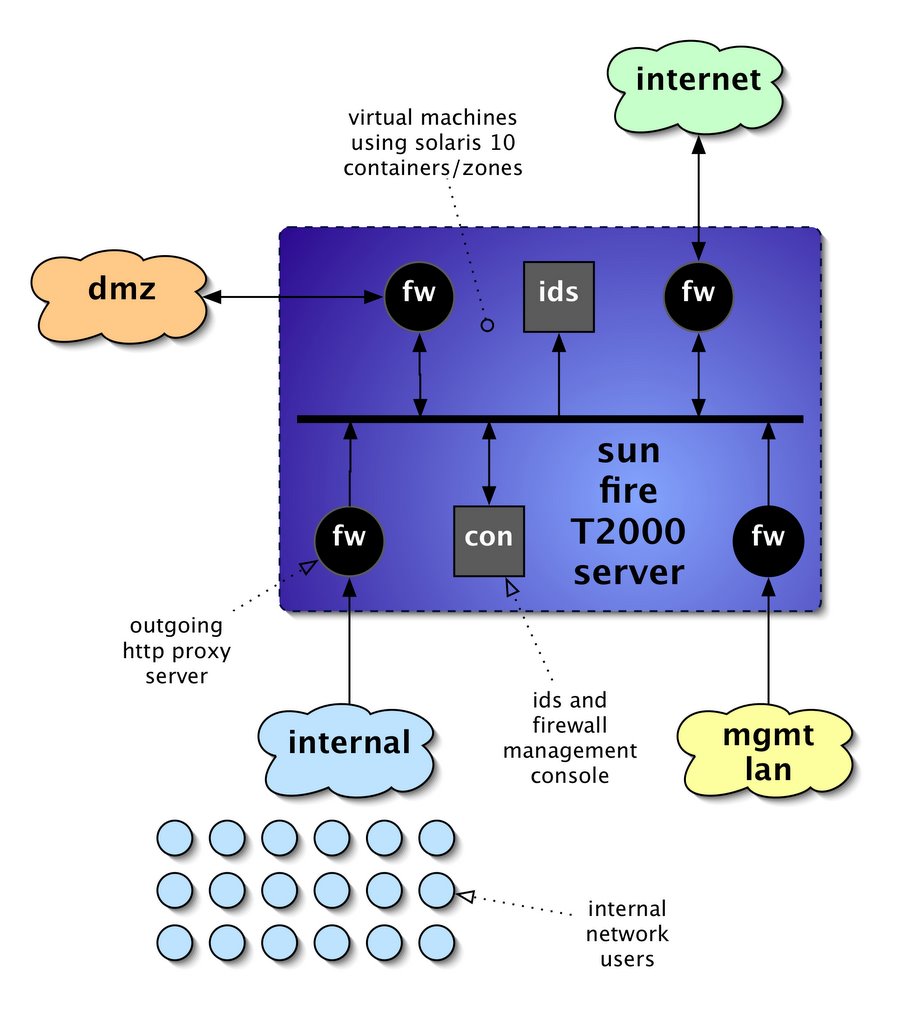
in the above diagram you can see that i intend to virtualise six instances, four firewalls, one ids sensor and a management system. the t2000 has four gigabit ethernet ports, which would be assigned to each of the four networks, while inter-machine communication and intrusion detection would all be done using the virtual internal network. it will be simple to allocate at least one cpu to each machine, and the resource pooling commands available will allow some of the virtual machines to have extra cpus allocated, perhaps the internet-facing firewall and the ids sensor. the sun bigadmin site has some useful resources on zones, including the original usenix paper describing the implementation.
the software to be installed will all be open-source packages, most of which are de-facto industry standards. i will use squid as the outgoing web proxy, snort as the network ids and use native solaris networking for the firewall rules. i will need to determine a suitable console to administer the firewalls, but sguil will be used for ids command and control.
a useful test would be to determine the line-speed that the firewalls and the ids are capable of handling without dropping any packets, and the number of simultaneous outgoing connections that the proxy will allow, while the dmz also has web traffic being sent to it from the internet. i believe that the t2000 should be a good platform for this kind of appliance, due to the one-box approach that can be taken, while not having to compromise on cpu power available. i intend to set this environment up over the next week and produce some performace figures to try and validate this claim.
15/03/2006
hardening solaris ten
hexagon, my sun fire t2000 system, was to harden the operating system. i want to make sure that the system is not going to be offering extraneous services to passers-by on the internet (even though everything but ssh will be firewalled off.) this will have the added bonus of stopping cpu being used unnecessarily. an initial portscan using the ubiquitous nmap utility revealed the following open ports:robot$ nmap -p1-65535 -A hexagon
Interesting ports on hexagon (10.10.10.6):
(The 65514 ports scanned but not shown below are in state: closed)
PORT STATE SERVICE VERSION
21/tcp open ftp Solaris ftpd
22/tcp open ssh SunSSH 1.1 (protocol 2.0)
23/tcp open telnet
25/tcp open smtp Sendmail 8.13.4+Sun/8.13.3
111/tcp open rpcbind 2-4 (rpc #100000)
513/tcp open login Berkeley remote login service
514/tcp open tcpwrapped
587/tcp open smtp Sendmail 8.13.4+Sun/8.13.3
898/tcp open http Solaris management console server
4045/tcp open nlockmgr 1-4 (rpc #100021)
5987/tcp open unknown
5988/tcp open unknown
7100/tcp open font-service Sun Solaris fs.auto
9010/tcp open tcpwrapped
22273/tcp open wnn6?
32771/tcp open status 1 (rpc #100024)
32772/tcp open fmproduct 1 (rpc #1073741824)
32773/tcp open rusersd 2-3 (rpc #100002)
32774/tcp open ttdbserverd 1 (rpc #100083)
32777/tcp open sometimes-rpc17?
32778/tcp open dmispd 1 (rpc #300598)
32779/tcp open snmpXdmid 1 (rpc #100249)
32795/tcp open unknown
Service Info: OSs: Solaris, Unix, SunOS
Nmap finished: 1 IP address (1 host up) scanned in 1778.040 seconds
as you can see, there's a lot of unwanted access provided there. at least ssh is there by default, but we also have telnet and rlogin, the X11 font server, as well as all those RPC services... solaris 10 manages services with the
svcxsxxx utilities, and i will use them to turn off telnetd and rlogin, as follows:root@hexagon# svcadm disable svc:/network/telnet
root@hexagon# svcadm disable svc:/network/login:rlogin
root@hexagon# svcadm disable svc:/application/x11/xfs
root@hexagon# svcadm disable svc:/network/ftp:default
root@hexagon# svcadm disable svc:/network/rpc/rusers
root@hexagon# svcadm disable svc:/network/rpc/rstat
root@hexagon# svcadm disable svc:/network/shell:default
and we can also get rid of the packages that provide
telnetd itself, since it is inherently insecure, and there is always potential access via telnet to the console over the ALOM network port. first, check what packages need removed, then remove them with the pkgrm utility:root@hexagon# pkginfo | grep -i telnet
SUNWtnetr Telnet Server Daemon (Root)
SUNWtnetc Telnet Command (client)
SUNWtnetd Telnet Server Daemon (Usr)
root@hexagon# pkgrm SUNWtnetr SUNWtnetd
hopefully, this has given you an idea of how to do all this manually. i also downloaded the sun solaris security toolkit which has a lot of useful scripts to automate the hardening process. the file you require is
SUNWjass-4.2.0.pkg.tar.Z and is only 600KB. you need to be registered with sun to download anything, but this is useful anyway, since you need an id to get the latest security patches, and also to access the sun update connection site.root@hexagon# uncompress SUNWjass-4.2.0.pkg.tar.Z
root@hexagon# tar xf SUNWjass-4.2.0.pkg.tar
root@hexagon# pkgadd -d . SUNWjass
Processing package instance <SUNWjass> from </root/install>
Solaris Security Toolkit 4.2.0(Solaris) 4.2.0
Copyright 2005 Sun Microsystems, Inc. All rights reserved.
Use is subject to license terms.
Using </opt> as the package base directory.
## Processing package information.
## Processing system information.
## Verifying package dependencies.
## Verifying disk space requirements.
## Checking for conflicts with packages already installed.
## Checking for setuid/setgid programs.
Installing Solaris Security Toolkit 4.2.0 as <SUNWjass>
## Installing part 1 of 1.
/opt/SUNWjass/Audit/disable-IIim.aud
/opt/SUNWjass/Audit/disable-ab2.aud
...etc...
/opt/SUNWjass/rules.SAMPLE
/opt/SUNWjass/sysidcfg <symbolic link>
[ verifying class <none> ]
Installation of <SUNWjass> was successful.
you'll notice that the package was loaded from
/root/install. this is because i modify the root user to have a different home directory. often / is a shared home directory for other system accounts and daemon user ids, and it's never a good ide to have the root .profile and other dot-files there. moving home is relatively easy though:root@hexagon# usermod -d /root root
root@hexagon# mkdir /root
root@hexagon# chmod 700 /root
root@hexagon# mv /.[a-zA-Z0-9]* /root/
and even all the existing dot-files get copied across. the jaas security toolkit has a large number of configurable options, which are documented in the reference manual. the security blueprints collection is also a good place to look for information. to secure your solaris system with the jaas tool, execute the hardening driver using the following command:
root@hexagon# /opt/SUNWjass/bin/jass-execute -d hardening.driver |
tee jaas-hardening.log
which will lock down your system, and place a log of all output into
jaas-hardening.txt. once this has completed, reboot to implement the changes. when you next login you will see that a security warning has been added:|-----------------------------------------------------------------|
| This system is for the use of authorized users only. |
| Individuals using this computer system without authority, or in |
| excess of their authority, are subject to having all of their |
| activities on this system monitored and recorded by system |
| personnel. |
| |
| In the course of monitoring individuals improperly using this |
| system, or in the course of system maintenance, the activities |
| of authorized users may also be monitored. |
| |
| Anyone using this system expressly consents to such monitoring |
| and is advised that if such monitoring reveals possible |
| evidence of criminal activity, system personnel may provide the |
| evidence of such monitoring to law enforcement officials. |
|-----------------------------------------------------------------|
which should be modified to comply with local legal requirements. also, the passwords for any existing users will have been expired, and a much more stringent policy is now in place. if an nmap scan is run against the system now, you will see that most ports are closed, except ssh and one other that will be investigated later:
$ nmap -p 1-65535 -A hexagon | tee entries/hexagon.ports.03.txt
Interesting ports on hexagon (10.10.10.6):
(The 65533 ports scanned but not shown below are in state: closed)
PORT STATE SERVICE VERSION
22/tcp open ssh SunSSH 1.1 (protocol 2.0)
22273/tcp open wnn6?
Nmap finished: 1 IP address (1 host up) scanned in 1814.355 seconds
next, i installed some useful extra utilities, from the sun freeware site. this has lots of GNU software compiled for SPARC on solaris 10, although you may want to check out sun's offerings from the solaris 10 companion dvd. sudo is a good replavement for the standard
su program, curl makes retrieval of files from the internet simple and lsof lists all files that a process has . once you have downloaded them, installstallation follows the same basic pattern. this is how i installed the SMClsof and SFWsudo packages:root@hexagon# gunzip lsof-4.76-sol10-sparc-local.gz
root@hexagon# ln -s /usr/sfw /usr/local
root@hexagon# pkgadd -d ./lsof-4.76-sol10-sparc-local
The following packages are available:
1 SMClsof lsof
(sparc) 4.76
Select package(s) you wish to process (or 'all' to process
all packages). (default: all) [?,??,q]: all
Processing package instance <SMClsof>
from </root/install/lsof-4.76-sol10-sparc-local>
lsof(sparc) 4.76
Vic Abell
Using </usr/local> as the package base directory.
## Processing package information.
## Processing system information.
2 package pathnames are already properly installed.
## Verifying disk space requirements.
## Checking for conflicts with packages already installed.
The following files are already installed on the system and are being
used by another package:
* /usr/local/doc
* /usr/local/man
* - conflict with a file which does not belong to any package.
Do you want to install these conflicting files [y,n,?,q] n
Do you want to continue with the installation of <SMClsof> [y,n,?] y
## Checking for setuid/setgid programs.
The following files are being installed with setuid and/or setgid
permissions:
/usr/local/bin/lsof <setgid bin>
Do you want to install these as setuid/setgid files [y,n,?,q] y
## Processing package information.
## Processing system information.
Installing lsof as <SMClsof>
## Installing part 1 of 1.
/usr/local/bin/lsof
/usr/local/doc &glt;conflicting pathname not installed>
/usr/local/doc/lsof/00.README.FIRST
/usr/local/doc/lsof/00CREDITS
/usr/local/doc/lsof/00DCACHE
/usr/local/doc/lsof/00DIALECTS
/usr/local/doc/lsof/00DIST
/usr/local/doc/lsof/00FAQ
/usr/local/doc/lsof/00LSOF-L
/usr/local/doc/lsof/00MANIFEST
/usr/local/doc/lsof/00PORTING
/usr/local/doc/lsof/00QUICKSTART
/usr/local/doc/lsof/00README
/usr/local/doc/lsof/00TEST
/usr/local/doc/lsof/00XCONFIG
/usr/local/doc/lsof/lsof.man
/usr/local/man <conflicting pathname not installed>
/usr/local/man/man8/lsof.8
[ verifying class <none> ]
Installation of <SMClsof> was successful
root@hexagon# bzip2 -d SFWsudo.bz2
root@hexagon# ln -s /usr/sfw /opt/sfw
root@hexagon# pkgadd -d ./SFWsudo
The following packages are available:
1 SFWsudo Sudo - superuser do
(sparc) 1.6.8.5,REV=2005.01.05.17.49
Select package(s) you wish to process (or 'all' to process
all packages). (default: all) [?,??,q]: all
Processing package instance <SFWsudo> from </root/install/SFWsudo>
Sudo - superuser do(sparc) 1.6.8.5,REV=2005.01.05.17.49
...and so on...
Installation of <SFWsudo> was successful.
root@hexagon# chmod u+s /usr/sfw/bin/sudo
important - notice that the sudo executable was not setuid root, and we had to change this after installation, to make it work! after this, the installs for any other packages will be very similar - use the above processes as a guide, just remember to check where in the filesystem things get installed, and either create symlinks or allow it as required. once sudo has been installed, you need to authorise users to have access to the root user. use the
visudo command as root, and setup the sudoers file. i added the following line, which gives everyone in the sysadmin group root access:%sysadmin ALL=(ALL) ALL
since we have lsof installed now, we can check what was holding the other port (22273/tcp) open. in the nmap output it is listed as wnn6? but we can check what process is using it with lsof and find as follows:
root@hexagon# lsof | grep -i wnn
jserver_m 741 root 3u IPv4 0x600036e0100 0t0 TCP *:wnn6 (BOUND)
jserver_m 741 root 4u IPv6 0x6000377f940 0t0 TCP *:wnn6 (LISTEN)
root@hexagon# find / -name "jserver_m" -print
/usr/lib/locale/ja/wnn/jserver_m
and we can see that it is a program called
jserver_m that seems to have something to do with the japanese locale input method. i don't live in japan, or speak japanese, so this can be safely turned off. checking with svcs shows that it is started by init and can be disabled as follows:root@hexagon# svcs | grep -i wnn
legacy_run 20:50:28 lrc:/etc/rc2_d/S94Wnn6
root@hexagon# /etc/init.d/Wnn6 stop
root@hexagon# mv /etc/rc2.d/S94Wnn6 /etc/rc2.d/_S94Wnn6.DISABLED
hopefully this has given you an idea of how best to approach hardening a solaris 10 system. the one thing not covered here is patching, which i will describe in another post. depending on how tightly you want things locked down initially, you can either manually turn off certain services or you can use sun's provided toolkit, and edit the default settings. this gives you a lot of flexibility, but i now have a system i feel safe about connecting to my router and assigning an IP address...